
Biden Extends Trump's Solar Tariffs With Some Changes
04 February 2022
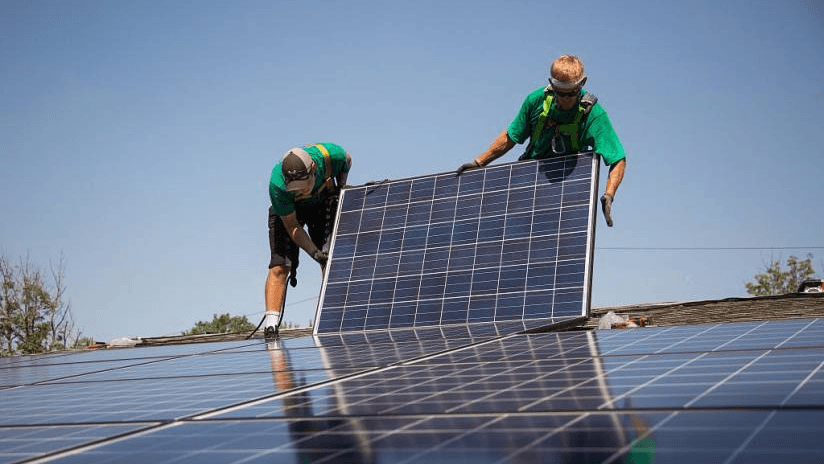
On Friday, the Biden administration said it would extend Section 201 of tariffs on imported solar panels and panels for another four years, but with a number of changes to existing regulations.
The tariff rate quota for solar panels will increase from 2.5 gigawatts to 5 gigawatts, and the administration will also support the decision to exclude bifacial panels from tariffs. Bifacial panels, which absorb light on both sides, are most common in utility-scale solar projects.
The Solar Energy Producers Association said that while it was "disappointed" by the decision, it "supported" the administration's efforts to find a middle ground.
"Administration officials came to a balanced solution by supporting an exemption for bifacial panels and increasing the tariff rate quota for the elements," Abigail Ross Hopper, the association's president and ceo, said in a statement.
The American Clean Energy Association said it "welcomes" the administration's decision to remove bifacial panels from tariffs, supporting the extension as a whole.
"The president's decision to extend the tariffs applicable to monoblock solar cells and modules gives the domestic solar industry another four years to adjust to competition with imports, as the law intended," Heather Zichal, ceo of the American Clean Energy Association, said in a statement.
The Section 201 solar tariffs were announced by former President Donald Trump in January 2018 and went into effect that same year. The four-year tariffs were due to expire on Sunday. The initial tariffs were 30% with an annual reduction of 5%.
In November, the U.S. International Trade Commission recommended that the tariffs be extended. The Commission said these measures are still "necessary to prevent or repair serious damage" to domestic industry.
"There is evidence that domestic industry is positively adapting to competition from imports," the commission said.
However, others argue that tariffs have done little to stimulate domestic production. According to Rystad Energy, the tariffs "comprehensively failed." In December, the company said the U.S. would import a record 3 gigawatts of solar panels in 2021, up from 2.5 gigawatts imported in 2019.
Energy research firm Wood Mackenzie noted that solar modules used in U.S. solar projects are 55% more expensive than in European projects due to layers of tariffs.
The decision comes amid turbulent times for the industry. Over the past year, shares of solar companies have crashed due to a number of factors, including rising raw material costs, supply chain bottlenecks and political uncertainty. More recently, this group has come under wide rotation from growth-oriented areas of the market in the face of rising rates.
This year, the Invesco Solar ETF index has fallen by 20%, which is 25% more than in 2021. Installation companies Sunrun, SunPower and Sunnova are trading about 70% below their 52-week highs. Enphase is more than 50% below its recent high.
Manufacturer First Solar is holding up a little better and is 42% below its 52-week high reached on Nov. 1. The company was among those who advocated for the extension of tariffs.
"First Solar is deeply disappointed by the decision to extend the section 201 safeguard duties while maintaining the exemption of bifacial panels," said First Solar CEO Mark Widmar. "Simply put, the extension of protective duties under Section 201, excluding bifacial panels, is not a protective measure at all."
Samantha Sloan, First Solar's vice president of policy, said Thursday that the cost of solar panels is less than 20% of the equalized cost of electricity for an average utility-scale solar project.
Potential changes to California's solar subsidy program also loom over the group. On Thursday, the state regulator said a decision on the matter had been postponed indefinitely.
Go to all articles
Read more
21 August 2026
Bitcoin surges 12% crosses $70,000: 5 key drivers behind the rally
19 August 2026
Bitcoin climbs towards $64,000 as cooling inflation and falling treasury yields aid recovery
17 August 2026
INSTITUTIONAL | Israel's Largest Bank Becomes the First Bank to Offer Crypto Trading
14 August 2026
Swissquote shares sink 10% as crypto slump prompts 2026 guidance cut By Investing.com
12 August 2026
Robinhood adds over 50 tokens to become an 'all-in-one' UK platform - AMBCrypto
10 August 2026
'I Thought It Was a Cambodia Trip': Sanitation Worker's Court Lie Brings Perjury Conviction
07 August 2026
After Earnings, Is Coinbase Stock a Buy, a Sell, or Fairly Valued?
05 August 2026
Hong Kong Woman Loses $3.3 Million in Fake Crypto App Romance Scam
03 August 2026
Cardano Climbs 10% As Investors Gain Confidence By Investing.com
31 July 2026
Why Is Robinhood Stock Rising Today? Strong Trading Activity Helps Beat Earnings Despite Crypto Slowdown
29 July 2026
Flipster Secures VARA Full Operational Exchange License, Advancing Regulated Crypto Services in the UAE
27 July 2026
XEM Sees 11.83% Slide Amid Mixed Crypto Market Signals
Do you need a customized plan for trading?
Effective assistance on various aspects of your trading account and other financial activities related to trading on the broker's platform.